


Are Black Friday Car Deals Actually Worth It? Bryant’s Guide to Spotting a Good Deal
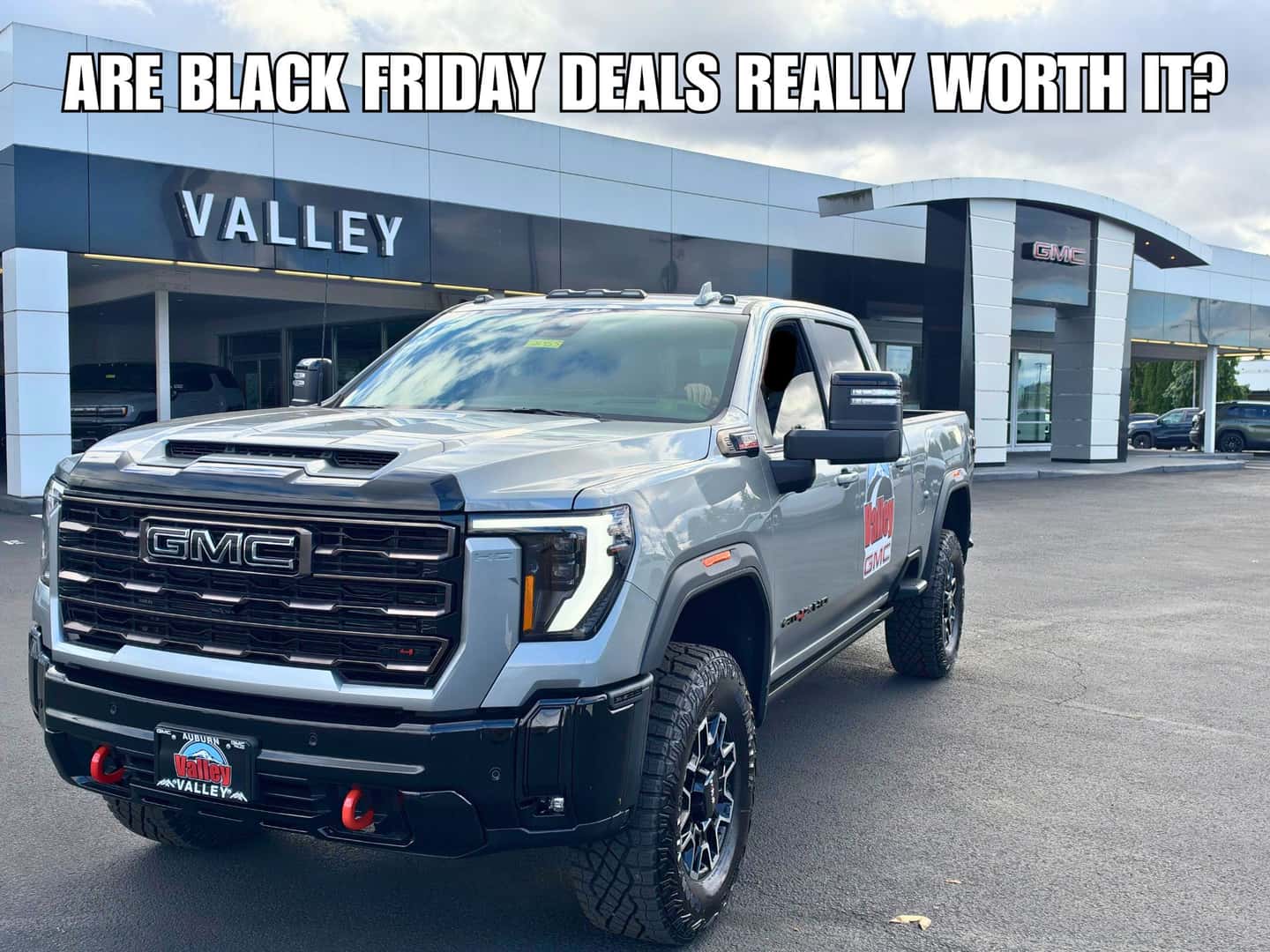
By Bryant Claudon, General Manager | Valley GMC, Auburn, WashingtonEvery November, my inbox starts filling up with Black Friday advertisements.Big discounts. Low payments. Limited-time offers. Enough exclamation points to make you think every vehicle in America is practically being given away.And every year, customers ask me the same question:
“Bryant, are Black Friday car deals actually worth it?”
My answer? Sometimes, absolutely.
But here’s something I’ve learned after years in the car business: A good deal isn’t determined by how big the sale banner is. It’s determined by the actual numbers and whether the vehicle is right for you.
Black Friday can be a great time to shop for a new car or truck. Manufacturers may offer incentives, dealerships may have special pricing, and shoppers have an opportunity to compare their options.
But before you get too excited about that giant red SALE sign, let me share a few things I’d look at if I were shopping.
1. Start With the Actual Selling Price
This sounds obvious, but it’s probably the most important place to start.
Let’s say you see a GMC Sierra 1500 advertised with thousands of dollars in savings.
That’s worth looking into. But I’d want to know a few things:
- What’s the manufacturer’s suggested retail price (MSRP)?
- What’s the dealership’s actual selling price?
- How much of the advertised savings comes from dealer discounts?
- How much comes from manufacturer rebates or incentives?
- Which incentives do I personally qualify for?
Those last two questions matter.
Some manufacturer incentives are available to a broad group of shoppers. Others may require current ownership or leasing of a qualifying vehicle, financing through a specific lender, or meeting other eligibility requirements.
And sometimes two attractive offers can’t be combined.
Bryant’s advice: Ask for the selling price, available incentives, and the total out-the-door price in writing. That makes comparing offers a whole lot easier.
2. Don’t Let a Low Monthly Payment Tell the Whole Story
I’ve met plenty of customers who start with the same question:
“Can you get my payment down?”
And that’s a fair question. Your monthly budget matters.
But a lower payment doesn’t automatically mean you’re spending less money.
For example, imagine you’re financing $40,000 at 6% APR.
- 60 months: Approximately $773 per month; approximately $6,399 total interest.
- 72 months: Approximately $663 per month; approximately $7,729 total interest.
Illustrative calculation only. Assumes a fixed 6% APR and $40,000 financed, with no additional fees. Not an advertised financing offer. Values are rounded.
The longer loan lowers the payment by about $110 a month, but it also adds roughly $1,330 in interest over the life of the loan.
Neither option is automatically wrong. The important thing is understanding the difference.
When comparing financing offers, look at the APR, loan term, amount financed, down payment, and total of payments.
And if you’re comparing a low-interest financing offer with a cash rebate, ask which option provides the better overall value for your situation.
Sometimes the answer isn’t the one with the flashiest headline.
3. Leasing? Read Beyond the Monthly Payment
Lease advertisements can look especially attractive during holiday sales.
But before comparing two leases, make sure you’re comparing the same things.
Look at the amount due at signing, lease length, annual mileage allowance, vehicle equipment, and any applicable end-of-lease charges.
A lease advertising a lower monthly payment might require substantially more money upfront. Or it might allow fewer miles than you actually drive.
That matters if your daily commute includes Auburn to Bellevue, or if your weekends involve towing gear and heading across Washington.
The right lease should fit how you actually use your vehicle.
Bryant’s advice: Ask for the complete lease terms, not just the monthly payment. A lease that looks inexpensive on paper isn’t necessarily the best fit for your driving habits.
4. Your Trade-In Is Part of the Equation
Here’s another place where shoppers sometimes get distracted.
A dealership might offer an attractive trade-in value, but that number should be considered alongside the selling price of the vehicle you’re buying.
For example, imagine two dealerships are quoting you on the same truck.
- Dealership A: Truck selling price $48,000; trade-in allowance $20,000; difference before taxes and fees $28,000.
- Dealership B: Truck selling price $46,500; trade-in allowance $18,000; difference before taxes and fees $28,500.
Hypothetical comparison, not actual Valley GMC pricing. Existing trade-in loan balances, taxes, fees, and other factors may change the final amount owed.
Dealership A offers $2,000 more for your trade, but Dealership B has a lower selling price.
The difference between those two numbers is what you need to compare, along with taxes, fees, any amount still owed on your trade, and financing terms.
The biggest trade-in number doesn’t necessarily mean the best overall deal.
5. Make Sure the Deal Is on the Vehicle You Actually Want
This is one of my favorites.
You find a great offer on a truck, and then realize it’s not the cab configuration you need, the trim you want, or the engine that makes sense for how you drive.
A GMC Sierra 1500 can be configured in several different ways. Cab size, bed length, engine, drivetrain, towing equipment, and trim can all affect the vehicle’s price and suitability.
And the same goes for family SUVs. If you need the additional cargo space of a GMC Yukon XL, a discount on a smaller vehicle doesn’t solve that problem.
A great price on the wrong vehicle is still the wrong vehicle.
Before you shop, figure out your non-negotiables.
If you’re shopping for a truck, our GMC Truck Bed Size Test is a fun place to start. We used actual trucks on our lot to show how different bed lengths handle the same piece of lumber.
Sometimes seeing it makes more sense than reading another page of specifications.
6. Would You Still Want This Vehicle Without the Sale?
This might be my favorite test of all.
Imagine taking away the Black Friday banner, the countdown clock, and the words “limited time.”
Would you still want that truck or SUV?
Does it fit your family? Your commute? Your budget? Your weekend adventures?
If the answer is yes, and the numbers make sense, then you’ve probably found something worth considering.
If the answer is no, don’t let a holiday promotion talk you into buying something you don’t really need.
I’ve never believed a customer should buy a vehicle just because somebody put a big red bow on the hood.
Although I will admit, the bows look pretty good in photos.
So, Are Black Friday Car Deals Worth It?
They certainly can be.
But there’s no guarantee that every Black Friday offer is better than what was available the week before, or what might become available in December.
Manufacturer incentives can change. Inventory changes. Financing programs change.
And the right time to buy depends on what you’re looking for and whether the numbers work for you.
My advice is simple: Compare the complete offer, not just the advertisement.
If you want to dig deeper into holiday shopping timing, we’ve also put together a guide comparing Black Friday vs. Cyber Monday truck deals.
And if you’re actively shopping, you can always review our current Valley GMC offers to see what’s available.
A Little Advice From the Valley
At Valley GMC, we’ve been part of the Auburn community for generations. My family has been in this business long enough to know that the best customer relationships don’t come from pushing someone into a purchase.
They come from helping people make decisions they feel good about.
If you’re shopping for a Sierra, Yukon, Yukon XL, or another vehicle this holiday season, come see us.
We’ll help you compare vehicles, understand the offers, and figure out what actually makes sense for you.
And if the best decision is to wait? That’s okay too.
Your needs, our priority.
See you in the Valley.
Bryant

Bryant Claudon, General Manager Valley GMC
Frequently Asked Questions About Black Friday Car Deals
Are Black Friday car deals really cheaper?
Sometimes. A Black Friday promotion may include manufacturer incentives, dealership discounts, or financing offers. Compare the actual selling price, eligibility requirements, and total cost against other available offers before deciding.
How can I tell if a Black Friday car deal is good?
Request a written out-the-door price, review applicable rebates, compare financing or lease terms, and confirm the offer applies to the exact vehicle you want. A good deal should fit your budget and driving needs.
Is 0% APR better than a cash rebate?
Not always. It depends on the rebate amount, financing rate, loan length, amount financed, and whether the offers can be combined. Ask for a side-by-side comparison of the total costs.
Should I trade in my vehicle during Black Friday?
You can, but compare the trade-in allowance and new vehicle selling price together. Also consider your existing loan balance and the total amount you’ll need to finance.
Should I buy on Black Friday or wait until December?
Neither month guarantees the lowest price. Waiting may bring different incentives, but the vehicle or configuration you want might no longer be available. Compare confirmed offers and your own timeline rather than relying on predictions.
Find the Right Deal for You
Shopping for a new GMC Sierra, Yukon, Yukon XL, or another vehicle? Our team in Auburn can help you compare actual vehicles, available incentives, and financing options without the pressure.
No giant red bow required.
0 comment(s) so far on Are Black Friday Car Deals Actually Worth It? Bryant’s Guide to Spotting a Good Deal