


Advice on Road-Tripping in Your EV

One reason for the popularity of battery electric vehicles (EVs) is that they are great for commuting. If you have a home charger, you plug it in when you get home so it’s fully charged the next morning and you never have to work in a fuel stop in your routine. That they also cost notably less per mile than gas vehicles is a good incentive for choosing your EV for a road trip. But is it a good idea? It could be, but you will have to plan ahead and possibly change your view of what a road trip is all about. Valley Buick GMC offers these guidelines for EV road-tripping.
A Focus on “Range”
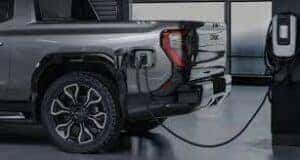
Ironically this most discussed figure when it comes to EVs is most accurate when it is least important. That is when always have the ability to charge to 100% overnight such as in commuting, where you are unlikely to use anything close to maximum range.
On the road, you will use fast DC charging where changing times change from overnight to maybe an hour or less. The catch is that for purposes of preserving battery life, it is recommended you only fast-charge to 80%. Plus, charging from 80 to 100% will double your charging time so squeezing in that last 20% isn’t worth it. So now, a 400-mile range Sierra EV will have a 320-mile range.
Weather also plays a part. EV batteries are surprisingly similar to people as their ideal temperature is about 72 degrees Fahrenheit with their effectiveness dropping off at temperatures significantly higher and lower than that. Add some possible inclines in the road, and maybe a headwind, and your range can reduce further. No one wants to roll up to a charger on their last mile. Fortunately, the more long trips you take, the better you can predict your EV’s range in given situations.
Planning your route around charging
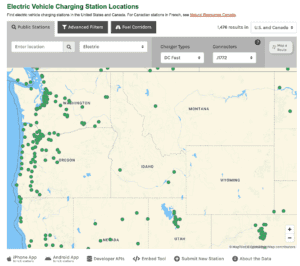 Scout out your charging locations prior to your trip and be sure to know your type of charger connection. GM vehicles use the J1772 connector, which has become standard for the industry. Tesla and early Nissan Leafs use different and incompatible connectors. The U.S. Department of Energy’s Alternative Fuels Data Center website has a map that pinpoints electric vehicle charging stations. It’s searchable by location, and you can filter results by charger types and connectors to help your charging plans.
More densely populated areas are more likely to have charging stations and you are also more likely to find them along interstate highways. You will want to have apps on your phone for both the major public charging networks such as ChargePoint and Electrify America. PlugShare is a great independent app that is rated at 4.8 and 4.9 stars on the GooglePlay and Apple App store. Some hotels now have overnight charging stations for guests so you will want to inquire about that when you make your lodging plans. If a particular hotel does not, look for charging stations within walking distance.
Very important in your plans is to have a generous buffer in your distances from charger to charger as well as backup plans. Look for chargers in a shorter distance than your planned charger in case your expected range falls short. Also, look for alternative locations in the area of your charger in case it isn’t working or is too backed up.
Keep a Loose Schedule
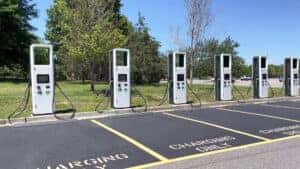 Depending on your EV and the starting level of charge, fast DC charging can take anywhere from a half hour to over an hour. Consider, however, that charging stations in remote areas of popular travel routes may be full when you get there. Unlike a five-minute wait behind someone getting gas, the wait could be equal to or longer than your charge time depending on the vehicle. Charging station technology is also relatively new and reliability could be better so don’t be surprised if you encounter a few non-working chargers during your trip.
Ideally, you will want to schedule your charging at meal times with an acceptable restaurant nearby. Don’t be surprised if everyone else with an EV wants to do the same so charge stations could be their most busy at traditional meal times in areas with a choice of restaurants. It may be advantageous for you and your traveling companions to be flexible regarding meal time. Also, if charging station availability is tight, it is good charging etiquette to monitor your charging progress and remove your vehicle from the location as soon as possible after it has reached 80%.
If your charging and meal times don’t match, check out other sights in the local area or plan on impromptu activities appropriate for your companions and the location to pass the time. Taking time to smell the roses is definitely a thing in current EV road-tripping.
It Will Keep Getting Better
Our existing road trip expectations are based on over 80 years of a continually growing gas-based transportation infrastructure. Changing over to a completely different form of transportation energy is bound to have some growing pains. What Valley Buick GMC considers the best news about EV long-distance driving is that it will constantly get easier. New chargers are going up every day, including at convenient locations such as truck stops, restaurant hubs, and hotel parking lots. New EV fast DC charge times are getting smaller, which is good news even for existing EV owners if they are waiting behind one of these fast-charging vehicles.
0 comment(s) so far on Advice on Road-Tripping in Your EV